 –
Mike's books
–
Mike's books
astronauticsnow.com/atusc/
Mike's space and rocket videos –
–
Mike's books
At USC. University of Southern California.
Transition ("tunneling effect") to USC. 30+ years at university.
At USC. University of Southern California.
Transition ("tunneling effect") to USC. 30+ years at university.
Excerpts from
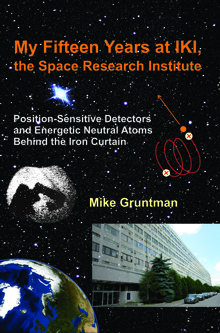
My Fifteen Years at IKI, the Space Research Institute:
Position-Sensitive Detectors and Energetic Neutral Atoms Behind the Iron Curtain
Interstellar Trail Press, 2022. ISBN 979-8985668704
detailed book content paperback hardcover Kindle book preview
Beginning of the "tunneling transition" story (in Preface)
Chapter 11. Separation of stages in powered ascent
Mission-critical event: separation of rocket stages (pp. 243-244)
<snip>
I am not prepared yet to describe how exactly the engine of the firtst stage of my space launcher cut ooff, how the explosive bolts were activated, and how the stages separated. In rocketry, it is usually a short process, only a few seconds long (Fig. 11.6) but requiring a long, meticulous preparation. It was no different in my case.
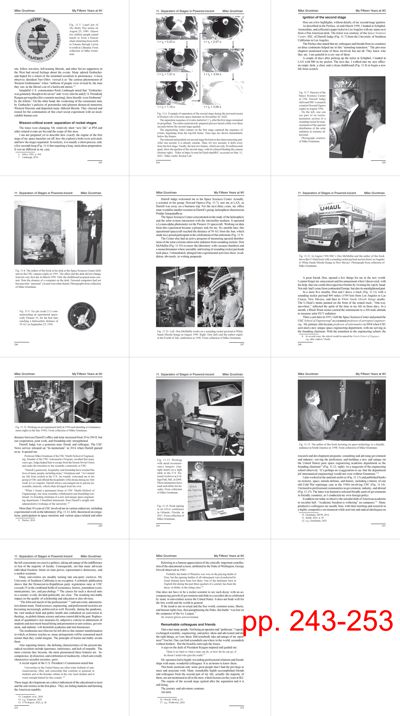
Ignition of the second stage (pp. 245-253)
Here are a few highlights, without details, of my second stage ignition.
As described in the Preface, in mid-March 1990, I landed at Schiphol, Amsterdam, and collected a paper ticket to Los Angeles with my name on it from a Pan American desk. The ticket was courtesy of the Space Sciences Center, SSC, of Darrell Judge (Fig. 11.7) from the University of Southern California in Los Angeles.
The Preface also stated that my colleagues and friends from six countries on three continents helped me in this "tunneling transition." The previous chapters mentioned some of those involved, but not all. They know who they are. I am grateful to every one of them. A couple of days after picking up the ticket at Schiphol, I landed at LAX with $80 in my pocket. The next day, I walked into my new office: an empty desk, a chair, and a clean chalkboard (Fig. 11.8) to begin a new life from scratch.
Darrell Judge welcomed me to his Space Sciences Center. Actually, a scientist in his group, Howard Ogawa (Fig. 11.7), met me at LAX, as Darrell was away on a business trip. For the next three years, my office mate would be another scientist in Darrell's group, heliospheric theoretician Pradip Gangopadhyay.
The Space Sciences Center concentrated on the study of the heliosphere and the solar system interaction with the interstellar medium. It operated a Lyman-alpha photometer on the Pioneer 10 spacecraft. Working on data from this experiment became a primary task for me. Six months later, this operational spacecraft reached the distance of 50 AU from the Sun, which made me a proud participant in the celebrations of this milestone (Fig. 11.9).
The Center also had an active program of measuring spectral distributions of the solar extreme-ultraviolet radiation from sounding rockets. Don McMullin (Fig. 11.10) oversaw the laboratory with vacuum chambers and a monochromator where assembly and testing of sounding rocket payloads took place. I immediately plunged into experimental activities there, in addition, obviously, to writing proposals.
A great friend, Don, opened a few things for me in the new world. I cannot forget my amazement and his amusement when I discovered, with his help, that one could often open beer bottles by twisting the cap by hand. Not only had I come from continental Europe, but also its unenlightened part.
In a mere five months, Don and I drove a truck (Fig. 11.11) with a sounding rocket payload 800 miles (1300 km) from Los Angeles to Las Cruces, New Mexico, and then to White Sands Missile Range nearby. The U-Haul's motto painted on the front of the rented truck, "One-way anywhere," reflected the spirit of the time in my life in those days. In a month, a Black Brant rocket carried the instruments to a 200-mile altitude to measure solar EUV radiation.
Three years later in 1993, I left the Space Sciences Center and joined the USC School of Engineering [8, In several years, the school would be named the Viterbi School of Engineering,after Andrew Viterbi] as a tenured professor of aerospace engineering. My primary title became professor of astronautics in 2004 when USC activated a new unique space engineering department, with me serving as the founding chairman. With the transition to the engineering school, the distance between Darrell’s office and mine increased from 20 to 200 ft, but our cooperation, joint work, and friendship only strengthened.
Darrell Judge was a generous man, friend, and colleague. The USC News service released an "In memoriam" in 2014 when Darrell passed away. It quoted me:
Professor Mike Gruntman of the USC Viterbi School of Engineering, founder of the USC Astronautics Program, recalled that many years ago, Judge helped him to escape from the former Soviet Union and make the transition to the scientific community at USC.
"Darrell's generosity, hospitality and friendship have touched the lives of many people, including mine," Gruntman said. "As I started my life from scratch in the U.S., he warmly welcomed me to his group at USC and offered the hospitality of his home during my first week in Los Angeles. Darrell always encouraged me to pursue my scientific interests, which often diverged from his own.
"When I found a permanent home at USC Viterbi [School of Engineering], our close scientific collaboration and friendship continued. As founding chairman of a new and unique space engineering department, I benefited immensely from Darrell's insight into administrative workings of the university." [9]
More than 30 years at USC involved me in various endeavors, including experimental work in the laboratory (Fig. 11.12, left); theoretical investigations; participation in space missions and various space-related and other research and development programs; consulting and advising government and industry; serving the profession; and building a new and unique (in the United States) pure space engineering academic department as the founding chairman [10] (Fig. 11.12, right). As a magazine of the engineering school observed, "It;s perhaps no exaggeration to say that the department [of astronautical engineering] would not exist without Gruntman." [11]
I also worked in the national archives (Fig. 11.13) and published books on rocketry, space, missile defense, and history, including a history of one old Cold War espionage case in the 1940s involving USC (Fig. 11.14). I lectured to professional communities in government, industry, and abroad (Fig. 11.15). The latter was limited to selected friendly parts of governments in friendly countries, as I conducted my own foreign policy.
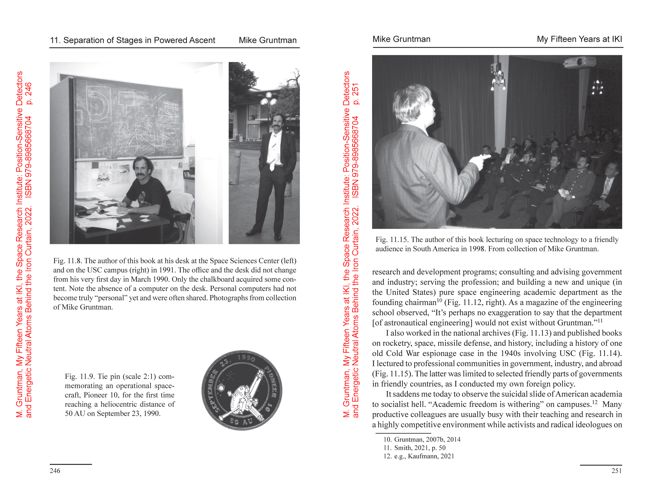
Fig. 11.8. The author of this book at his desk at the Space Sciences Center (left) and on the USC campus (right) in 1991. The office and the desk did not change from his very first day in March 1990. Only the chalkboard acquired some content. Note the absence of a computer on the desk. Personal computers had not become truly "personal" yet and were often shared. Photographs from collection of Mike Gruntman.
Fig. 11.9. Tie pin (scale 2:1) commemorating an operational spacecraft, Pioneer 10, for the first time reaching a heliocentric distance of 50 AU on September 23, 1990.
Fig. 11.15. The author of this book lecturing on space technology to a friendly audience in South America in 1998. From collection of Mike Gruntman.
It saddens me today to observe the suicidal slide of American academia to socialist hell. "Academic freedom is withering" on campuses. [12] Many productive colleagues are usually busy with their teaching and research in a highly competitive environment while activists and radical ideologues on the left concentrate on coercive politics, taking advantage of the indifference or fear of the majority of faculty. Consequently, not that many advocate individual freedom, limits on state power, representative democracy, and a market economy.
Many universities are steadily turning into one-party enclaves. My University of Southern California is no exception. A scholarly publication shows that the Democrat-to-Republican party registration ratio at USC exceeds 25 in the combined fields of economics, history, journalism (communications), law, and psychology. [13] The causes for such a skewed ratio in a country evenly divided politically are clear. The resulting inevitable impact on the quality of scholarship and education is also obvious.
"The leftward march of the professoriate" [14] and university administrators alarms many. Hard sciences, engineering, and professional societies are becoming increasingly politicized as well. Recently, during the pandemic, the vital medical field and public health also embarked on conversion to theology, as global climate science and arms control did in the past. Replacement of quantitative test measures by subjective criteria in admissions of students and non-merit based hiring and promotion in universities, government, and industry will demolish academia and ruin businesses.
The totalitarian neo-Marxist far left drives this sinister transformation in which, as history teaches us, many protagonists will be consumed much sooner than they could imagine. The principle of karma inevitably awaits them.
Also repeating history, the defining characteristics of the present-day radical socialists include ignorance, intolerance, and lack of empathy. The more extreme they become, the more pronounced these features are. Incompetence, dysfunction, and celebration of mediocrity, which universally characterize socialist societies, grow.
A recent report of the U.S. President's Commission noted that
Universities in the United States are often today hotbeds of anti-Americanism, libel, and censorship that combine to generate in students and in the broader culture at the very least disdain and at worst outright hatred for this country. [15]
These tragic developments are a direct indictment of the educational system and the universities in the first place. They are failing students and harming the American republic.
Referring to a famous appreciation of the critically important contribution of the educational system, attributed to the Duke of Wellington, George Orwell observed in 1941:
Probably the battle of Waterloo was won on the playing-fields of Eton, but the opening battles of all subsequent wars [conducted by Great Britain] have been lost there. One of the dominant facts in English life during the past three quarters of a century has been the decay of ability in the ruling class. [16]
One does not have to be a rocket scientist to see such decay with an accompanying growth of government and slide to a socialist abyss celebrated by many in universities across the United States. It does not bode well for the free world and the world in general.
If the trend is not reversed and the free world, common sense, liberty, and human rights lose, then paraphrasing the Duke, this battle "was lost on the campuses of the Ivy League."
Sic transit gloria universitatum.
Sputnik Explorer Vanguard Astronautics Missile defense Baikonur Tyuratam Saryshagan Rocket equation Rocket espionage U-2 Neil Armstrong USC
Mike's books
–
Mike's space and rocket videos –
Make the world a better place