 –
Mike's books
–
Mike's books
astronauticsnow.com/low_e_ena_pss/
Mike's space and rocket videos –
–
Mike's books
Direct Detection of Low Energy Atoms in Space
A new technique for in situ measurement
of the composition of neutral gas
in interplanetary space
Mike Gruntman
A new technique for in situ measurement
of the composition of neutral gas in interplanetary space
Planetary and Space Science
v. 41, No. 3, pp. 307-319, 1993
Article pdf
A recently published book describes an unusual story about the preparation and appearance of this article about a new, enabling surface-conversion experimental technique that is widely used (e.g., space missions IMAGE, IBEX, IMAP, etc.) in space research today; see http://astronauticsnow.com/negativeions/index.html.
Sputnik Explorer Vanguard Astronautics Missile defense Baikonur Tyuratam Saryshagan Rocket equation Rocket espionage U-2 Neil Armstrong USC USC Astronautics
A new technique for in situ measurement
of the composition of neutral gas
in interplanetary space
Planetary and Space Science, v. 41, No. 3, pp. 307-319, 1993
article pdf
Abstract
Neutral atoms filling interplanetary space play an important role in many processes relevant to the formation and evolution of the Solar System. A novel experimental approach for in situ atom detection is proposed. The technique is based on the conversion of neutral atoms to negative ions at a specially prepared sensitive surface. Negative ions are subsequently analyzed and detected in an essentially noise-free mode. As an application of the technique, in situ study of the composition of neutral interstellar atoms that penetrate the Solar System from the local interstellar medium is considered. It is shown that interstellar H, D and O atoms as well as, possibly, H2 molecules can be measured by the proposed technique. The experiment can be performed from a high-apogee Earth-orbiting satellite or from a deep space probe. Other possible applications of the technique are discussed briefly.
Introduction
A study of the interstellar gas (ISG) from the local interstellar medium (LISM) is a source of unique information on the properties of the LISM. Measurements of the LISM characteristics present the only opportunity to directly explore interstellar space. Study of the ISG should lead also to a better understanding of the processes of the interaction of the expanding solar wind flow with the LISM, building up of the heliosphere, and related phenomena. Neutral gas, although it is sometimes overlooked, is the most abundant constituent of the heliosphere. If one excludes the Sun, planets and other celestial bodies, then 98-99% of the mass of matter filling the heliosphere is represented by ISG and the remaining 1-2% is the solar wind plasma. The study of the heliosphere and the morphology of its boundary could provide a basis for a self-consistent theory of the interaction between the LISM and the solar wind, check and set limits on concepts of the origin of anomalous cosmic rays (ACRs) and test models of solar wind anisotropy and plasma flow loading.
This work is devoted to the discussion of a new approach to measure, in situ, part of the composition of interstellar gas that has entered the Solar System. The proposed technique is sensitive to H, D and O atoms, and in certain conditions, interstellar H2 molecules could be measured. Direct experimental data on D and O atoms as well as H2 molecules are unavailable for the LISM. Such abundant components of the ISG as He, Ne and N atoms cannot be measured with the proposed technique. The study of the properties of the LISM is considered as being important and scheduled for the year 1995-2015 by the most recent NASA Space Physics Strategy-Implementation Study (1991). Ideas presented here are the development of the experimental approach first outlined consistently by Gruntman (1991).
A study of the composition of the ISG is a field of astrophysics that may provide critical evidence for Big Bang cosmology and the theory of stellar formation and evolution. An accurate measurement of the D-to-H ratio could potentially provide the most important constraints on Big Bang cosmology (Boesgaard and Steigman, 1985). In this respect, such a measurement can be compared with the measurement of background microwave radiation. The D-to-H ratio is notoriously hard to measure and this ratio in the interstellar medium is believed to be in the range of (0.8-2)×10^(-5). The experimental knowledge at the present day is based on the measurements of absorption of Lyman lines in the U.V. and on the observation of deuterated molecules in interstellar gas in the millimeter wavelength range. However, the interpretation of observations is severely complicated by stellar contamination of the interstellar profiles and multiple clouds in the line of sight in the case of Lyman lines, and by chemical and physical fractionation in the case of deuterated molecules (Wannier, 1980; Boesgaard and Steigman, 1985). The detection of D in cosmic rays is irrelevant to the problem because this component is born of the breakup of the primary cosmic ray He nuclei (Hsieh et al., 1971; Mewaldt, 1989).
Interstellar atomic 0 abundances are of interest for the theories of formation and evolution of the stars (Wannier, 1980). On the "local" scale, 0 from the LISM is believed to contribute to the O component of ACRs (Fisk et al., I974; Cummings and Stone, 1990). Comparison of the O number density in the LISM, derived from anomalous cosmic ray observations, with the number density from independent in situ measurements would test proposed mechanisms for the formation of anomalous cosmic rays and cosmic ray particle acceleration in general.
Measurements of the local composition of the ISG could provide unique information on the homogeneity of the ambient interstellar cloud. There is some evidence of the inhomogeneity of the gas on such small scales as ∼25 a.u. in the ISG clouds (e.g., Diamond et al., 1989). It is believed that the Sun moves relative to the surrounding LISM with a velocity of 4-5 a.u. year^(-1). Change of the observed ISG density and composition with time would be an indication of the inhomogeneity of the ISG on a local scale.
An expanding supersonic flow of the solar wind interacts with the LISM forming the heliosphere. The structure of the heliosphere and its boundary, as well as properties of the LISM are of fundamental interest and the available experimental data are scarce and indirect. Most of our knowledge of the LISM properties is as a result of astronomical observations and study of the ISG flowing into the solar system. Astronomical measurements are, by their nature, not local and provide characteristics averaged typically over many parsecs (Frisch, 1990). Study of the inflowing ISG, until recently, was performed by optical, integral measurements and derived ISG characteristics were essentially model dependent. The ISG flow was studied extensively both theoretically and experimentally (see reviews by Axford, 1973; Fahr, 1974; Holzer, 1977; Thomas, 1978; Bertaux, 1984; Suess, 1990; Baranov, 1990). There is multiplying evidence that the interaction of the neutral ISG atoms with plasma flows in the heliospheric interface should affect substantially the characteristics of the neutral atoms reaching the inner parts of the solar system (Ripken and Fahr, 1983; Fahr, 1986; Baranov, 1990; Baranov et al., 1991; Fahr, 1991; Osterbart and Fahr, 1992; Baranov and Malama, 1993). The interaction of neutral atoms with plasma occurs mostly through charge exchange and by directly measuring interstellar H, D, He and O atoms that have entered the solar system, one can hope to get an insight into the physical processes in the heliospheric interface.
Neutral ISG from the LISM penetrates our solar system. and some interstellar atoms reach the Earth's orbit. This phenomenon presents naturally an opportunity to directly measure the interstellar atoms in interplanetary space and thereby determine the composition of the ISG. A substantial improvement in understanding the inflow of the ISG could be expected from the in situ detection of the interstellar particles. Direct detection was recently spectacularly demonstrated for the first time by the GAS experiment on the Ulysses spacecraft, where the instrument was capable of measuring the local velocity distribution function of interstellar helium atoms (Rosenbauer et al., 1984; Witte et al., 1992, 1993). In another planned experiment, energetic neutral H atoms born in the heliospheric interface will be observed by instruments aboard the Relikt-2 mission (Gruntman et al., 1990 [pdf]; Gruntman, 1992 [pdf] ). Direct detection of other species of interstellar origin should dramatically enhance our understanding of the properties of the LISM and its interaction with the solar system.
The best possible place to perform measurements of the ISG composition is from a fast-moving interplanetary spacecraft, far from planetary magnetosphere/exosphere influence and as far as possible from the Sun itself. An ideal mission is the proposed Interstellar Probe (The Interstellar Probe, 1990; Space Physics Missions Handbook, 1991). However, essential measurements could be made from an Earth-orbiting spacecraft with a high-apogee (≥ 100,000 km) orbit.
At first, the penetration of the interstellar neutral atoms into interplanetary space is considered and the expected fluxes of interstellar atoms are presented for an observer at the Earth's orbit. The proposed experimental approach is then outlined, and some details of relevant instrumentation are discussed, in particular, the conversion of neutrals to negative ions on surfaces. Finally, other possible applications of the technique are considered briefly.
Penetration of neutral atoms into interplanetary space
Direct in situ measurements of the ISG could be performed from various types of spacecraft. We will concentrate here on the estimate of the expected fluxes of interstellar atoms at the Earth's orbit, since that seems to be the place for the most feasible experiment. Besides atoms of H, D, and O and H2 molecules, for consistency, the He atoms are also considered. The ISG inflow into the solar system is considered in detail in a number of reviews, e.g. Axford, I973; Fahr, 1974; Holzer, 1977; Thomas, 1978. The ISG temperature "at infinity", T_0, is assumed to be zero, and calculations of neutral particle flux characteristics are performed following the procedure given by Fahr (1968). Neither the heliosphere interface effect nor the fractional ionization of the ISG (see Fahr, 1990) are taken into account.
For the purpose of this work, several simplifying assumptions are justifiable. Let us assume that an observer moves together with the Earth along its circular orbit (radius R_0 = 1 a.u.) around the Sun. The ISG velocity relative to the Sun is V_0 = 20 km s^(-1) and, its vector is in the ecliptic plane (Fig. 1). The assumption T_0 = 0 results in large errors while calculating characteristics of interstellar H and D atoms in the wake region. Such an assumption simplifies the calculations dramatically and provides a relatively good approximation for the characteristics of neutral interstellar atoms at angles θ < 150°; the angle θ is counted from the direction antiparallel to the ISG velocity relative to the Sun (Fig. 1). For heavier elements, like He and O atoms, this "cold gas" approximation is valid outside a narrow downwind cone. Another important common assumption is that interstellar atoms move independently along Keplerian orbits under constant forces of solar gravitational attraction and radiation pressure. Interstellar atoms are ionized (i.e. are lost for our purpose) by solar radiation and by charge exchange with the solar wind ions. The ionization rate is assumed to be inversely proportional to the square of the distance from the Sun and equal to β_0 at the Earth's orbit.
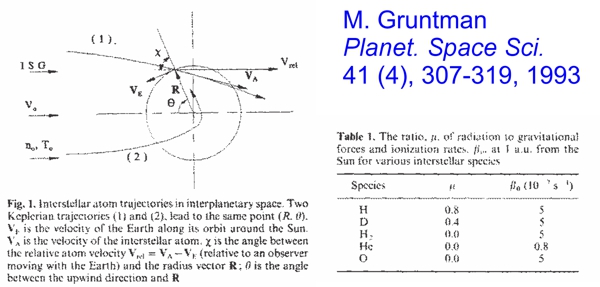
Fig. 1. Interstellar atom trajectories in interplanetary space. Two Keplerian trajectories (I) and (2), lead to the same point (R,θ). V_E is the velocity of the Earth along its orbit around the Sun. V_A is the velocity of the interstellar atom. χ is the angle between the relative atom velocity V_rel = V_A - V_E (relative to an observer moving with the Earth) and the radius vector R; θ is the angle between the upwind direction and R.
Table 1. The ratio, μ, of radiation to gravitational forces and ionization rates, β_0, at 1 a.u. from the Sun for various interstellar species.
The differences in radiation pressures and ionization rates lead to the differences in the populations of interstellar atoms in interplanetary space. Values used for the ratio of radiation to gravitational forces, μ, and ionization rates, β_0, for various species are given in Table 1. Although the radiation force is very different for He, H2, and O, it is much smaller than the gravitational force, and the ratio, μ, of the forces is equal to zero. As a consequence, the trajectories of H2, He and O particles are identical since μ is the same. However, the number densities of these species would differ because of their different ionization rates. The direction of the arrival of an interstellar particle to the observation point is described by the angle χ between the relative velocity vector, V_rel, and radius vector R (Fig. 1). Two trajectories of neutral atoms lead to any given point (R,θ). Only trajectories with angle θ sweeping less than 180° are considered further [trajectory (1) in Fig. 1]. For such a trajectory, the survival probability is higher than for particles moving to the same point along trajectory (2). All the following calculations are performed further for an observer moving with the Earth. Details of the calculations can be found in Gruntman (1991).
The dependence of the particle relative velocity, V_rel, on the angle θ is shown in Fig. 2 for H, D and O atoms. For interstellar He atoms and H2 molecules, the velocity is the same as for O atoms. The dependence of the particle relative energy, E_rel, on the angle θ is shown in Fig. 3 for H, D, and H2. For interstellar He and O atoms, the energy is a factor of 2 and 8 larger, respectively, than the energy of H2 molecules. The dependence of the angle of arrival, χ, on the angular position along the Earth's orbit, θ, for interstellar H, D and O atoms is presented in Fig. 4. Again, the interstellar He atoms and H2 molecules have the same dependence on θ as O atoms. The dependence of the fluxes of interstellar H, D and O atoms (normalized to the corresponding fluxes in the unperturbed ISG far from the Sun) on the angular position, θ, is shown in Fig. 5. He atoms are ionized with a much smaller ionization rate (see Table 1), and, correspondingly, their flux is substantially higher.
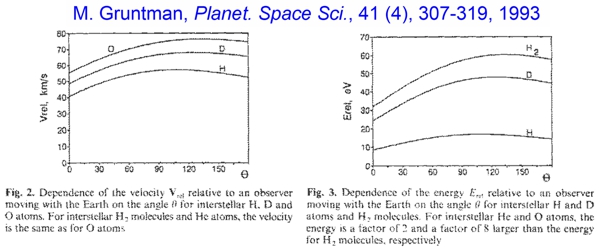
Fig. 2. Dependence of the velocity V_rel relative to an observer moving with the Earth on the angle θ for interstellar H, D and O atoms. For interstellar H2 molecules and He atoms, the velocity is the same as for O atoms.
Fig. 3. Dependence of the energy E_rel relative to an observer moving with the Earth on the angle θ for interstellar H and D atoms and H2 molecules. For interstellar He and O atoms, the energy is a factor of 2 and a factor of 8 larger than the energy for H2 molecules, respectively.
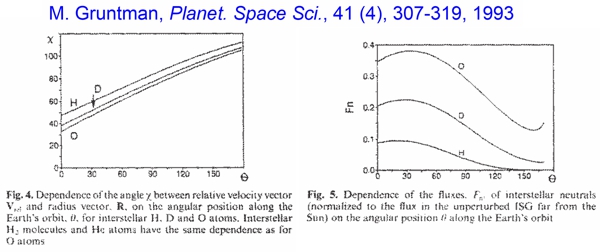
Fig. 4. Dependence of the angle χ between relative velocity vector V_rel and radius vector, R, on the angular position along the Earth's orbit, θ, for interstellar H, D and O atoms. Interstellar H2 molecules and He atoms have the same dependence as for O atoms.
Fig. 5. Dependence of the fluxes, F_n, of interstellar neutrals (normalized to the flux in the unperturbed ISG far from the Sun) on the angular position θ along the Earth's orbit.
It is important to note that D atoms not only have higher relative velocities than H atoms, but also they are expected to come from a direction which is different (6°-10°) from that of H atoms. Furthermore, interstellar H2 molecules as well as O atoms come from different directions also. The spread of the angles at which atoms are coming to a given point would be determined by the ISG temperature, and this spread is roughly inversely proportional to the square root of the mass of particles. For example for T_0 = 10^4 K, a scatter of H atoms at the position of an observer at, say, θ = 120° would be about ±10° and a scatter of D,atoms would be ±7° (Gruntman, 1991). Because of these differences in kinematic characteristics, as well as the dependence of the fluxes on angle θ (Fig. 5), one can expect the ratio of D to H fluxes into an instrument to vary depending on the position and on the direction of observation. The same is valid also for the ratio of the flux of H2 molecules to that of H atoms.
For realistic number densities of major constituents of the ISG in the LISM, i.e. n_H = 0.1 cm^(-3) and n+He = 0.01 cm^(-3), , one can expect that number densities of D and O atoms would be of the order n_D = 10^(-6) cm^(-3) and n_O = 10^(-4) cm^(-3), correspondingly. As far as the number density of H2 molecules is concerned, the situation is uncertain and it is not completely excluded that they may constitute a substantial part of the ISG. The total fluxes of H, D and O atoms in the unperturbed LISM that are used to normalize the expected values of fluxes at the Earth's orbit in Fig. 5, are then the following:
F_H = n_H V_0 = 2×10^5 cm^(-2) s^(-1)
F_D = n_D V_0 = 2 cm^(-2) s^(-1)
F_O = n_O V_0 = 2×10^2 cm^(-2) s^(-1)
The expected number densities of interstellar atoms at the Earth's orbit at θ = 0 are 5×10^(-3), 0.8×10^(-7) and 1.3×10^(-5) cm^(-3) for H, D and O atoms, respectively. The important result of the presented calculations is that expected fluxes (cm^-2) s^(-1) sr^(-1)) of different interstellar atoms depend in different ways on position and direction of the observation. This fact provides a basis for the unambiguous determination of the composition of the ISG from measurements performed at the Earth's orbit. It is highly desirable to detect and to determine the kinematic characteristics of interstellar neutral atoms during at least a 1 year period of time while an observer is "traveling" with the Earth along its orbit around the Sun.
Experimental conditions and new detection approach
For very low neutral particle number densities, any conventional experimental technique based on electron impact ionization of the neutral atoms and subsequent analysis and detection of the positive ions is not applicable. The lower limit of neutral density that can be detected by a state-of-the-art mass spectrometer, such as accepted for Cassini and CRAF missions, is about 4×10^4 cm^(-3). In some exceptional cases, when an instrument is deeply cooled (as it was on Apollo 17 during lunar nighttime), the sensitivity could be improved up to 10^2 cm^(-3) (Hoffman et al., 1973).
The expected ISG number density is much less than 10^(-1) cm^(-3), and therefore an application of the conventional experimental technique is completely ruled out. The idea behind the approach proposed here is to use an instrument sensitive to the flux of neutral particles instead of an instrument sensitive to the neutral particle number density. A small (few km s^(-1)) neutral gas velocity relative to the spacecraft would result in a large flux of atoms and molecules into the instrument. Then, even a small overall detection efficiency of individual particles by the instrument should result in a very high instrument sensitivity to the neutral particle number density.
One possibility to build an instrument sensitive to the neutral particle flux is to use secondary electron emission from a sensitive surface bombarded by the incoming flux. However. interplanetary space is inhospitable to such measurement techniques because of the intense e.u.v./u.v. background radiation which would efficiently produce photoelectrons. Another possibility has been utilized by Rosenbauer et al. (1984) for the detection of the flux of interstellar helium atoms and it is based on secondary ion emission due to atom bombardment of the sensitive surface. [An application of a slotted disk velocity selector, such as described by Moore and Opal (1975), is of historical interest only.] This technique, however, is not capable of mass analysis.
The new approach proposed here is based on the particle conversion on the surface into negative ions and subsequent analysis and detection of these ions. It is important that negative ions are not present in the ambient solar wind plasma in interplanetary space. For example, the lifetime of a negative H ion is about l/25 s at 1 a.u. from the Sun. In addition, all charged particles of energies <200 keV can be prevented from entering an instrument by a charged particle deflection system at the entrance. Hence, negative ions are unique in the sense that they are born only as a result of the interaction of the incoming neutral particle Aux with a specially prepared conversion surface in the instrument. Such a conversion technique has been well developed in laboratory applications, mostly for the production of high-intensity negative H/D ion beams that, after stripping, are used for fusion plasma energy pumping (e.g. Kleyn, 1990).
The atom conversion on surfaces to negative ions for detection purposes was first suggested and demonstrated by Hiskes and Karo (1978) and Massmann et al. (1979). Later the same plasma diagnostics application was emphasized by Van Wunnik and Los (1983) and Schneider et al. (1983). The most recent implementation of the technique for the fusion plasma diagnostics is given by Van Toledo et al. (1992). The use of the neutral atom conversion to negative ions was first suggested for space application by Gruntman and Leonas (1983) [pdf] and the concept was worked out later in detail by Gruntman (1991, 1993a [pdf]) and Gruntman et al. (1991 [pdf]). Neutral atoms and molecules after collision~reflection with certain types of surfaces acquire (with a relatively high efficiency) negative charge, i.e. become negative ions. The efficiency of such a conversion depends on the type of atom, the atom's initial velocity, angle of incidence and the type of surface with which it interacts. All atoms which can form negative ions can be studied by the proposed technique. The negative ions, and hence the incoming neutral atoms, could be identified, i.e. their mass could be reliably determined by a magnetic particle analyzer. The addition of a time-of-flight (TOF) analyzer would provide not only an independent particle identification but also the negative ion detection in a coincidence mode which eliminates the problem of the background count rates of detectors due to stray photons and particles within the instrument. The latter feature is of great importance for the ISG study because fluxes of such minor interstellar gas constituents as O and especially D are extremely low, and essentially noise-free "assured" detection is crucial for long accumulation times.
Such an instrumental arrangement should provide extremely high sensitivity, 10^(-1)-10^4 (count s^(-1))/(particle cm^(-3)), depending on species and experimental conditions, which is orders of magnitude better than in existing instruments. The dramatic increase in sensitivity would allow direct, in situ study of dilute neutral gas in space. Basically the proposed technique would allow one to determine the mass of the particles and to measure the neutral particle flux distribution over the sky, i.e. over directions of the particle arrival at the point of observation. The latter feature is not unlike the experiment of Rosenbauer et al. (1984) and Witte et al. (1992). The first in situ measurement of the interstellar H atoms and such important ISG minor components as atomic D and O will be possible. Other applications are discussed in a later section.
Generic scheme of the instrument
The general scheme for the detection and analysis of neutral particle fluxes is presented in Fig. 6. Charged particles, ions and electrons are prevented from entering the instrument by either an electrostatic or magnetic deflection system (not shown). The set of baffles determines the field of view of the instrument. Incoming neutral particles (N) hit the sensitive/conversion surface (CS) and are converted with a certain probability to negative ions. The negative ions are accelerated and momentum-selected in the magnetic analyzer before entering the TOF analyzer for final detection. Background e.u.v./u.v. photons produce secondary electrons from the CS which are detected by an electron detector D, (channel electron multiplier) providing a simple monitor of the conditions on the conversion surface. TOF measurements are the most effective means to eliminate background counts. The TOF section should provide an assured, essentially noise-free detection and additional identification of the mass-selected negative ions. and hence incoming neutral atoms. A special surface preparation and activation device (SPAD) is used to refresh and/or to activate the CS.
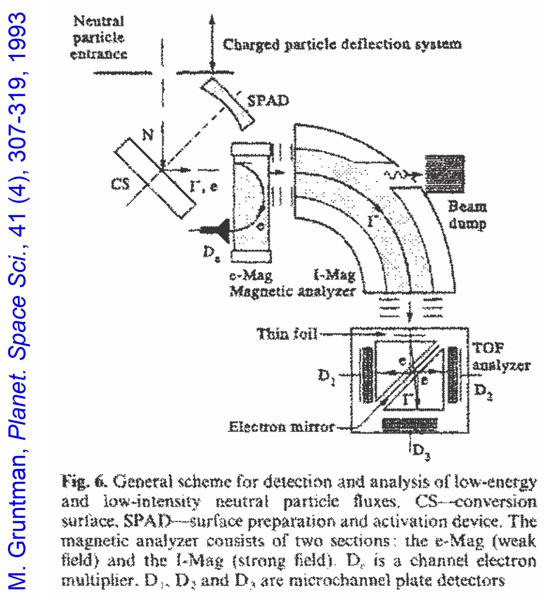
Fig. 6. General scheme for detection and analysis of low-energy and low-intensity neutral particle fluxes. CS - conversion surface, SPAD - surface preparation and activation device. The magnetic analyzer consists of two sections: the e-Mag (weak field) and the I-Mag (strong field). D_e is a channel electron multiplier, D_1, D_2 and D_3 are microchannel plate detectors.
The instrument design can be optimized for the species to be measured and experimental conditions. In fact, the use of either a magnetic or TOF analyzer is sufficient for negative ion mass identification. However, the use of these two analyzers in tandem would enhance instrument capability to detect exceptionally weak fluxes of neutral atoms, such as that of interstellar D.
Two major requirements would determine instrument configuration, viz. the necessity to scan mass range and the absolute value of the expected neutral particle flux. If only one type of atom is to be detected then ions are accelerated up to a certain fixed voltage and no scanning is required. If several species are to be measured, e.g. components of the ISG or neutral atoms and molecules in a celestial body environment, then it is necessary to scan the energy (and consequently mass) of negative ions, allowing the passage of selected masses through the magnetic analyzer. In this case the instrument is a scanning device, consecutively measuring one selected ion species at a time. If the flux of incoming neutral atoms is relatively high, then there is no need for a TOF section, and simple ion detectors, such as channel electron multipliers, could be used. For low neutral atom flux intensity, or measurement of trace species, a TOF section is indispensable for both independent mass identification and noise count rejection.
Both the magnetic analyzer and TOE section are not novel and will not be discussed here. It is sufficient to mention that a TOF section has become more or less a standard feature of many space instruments (e.g. Wilken, 1984) and a magnetic analyzer can be built using rare earth (e.g. CoSa) permanent magnets which would provide a magnetic field up to half a tesla (e.g. Voss et al., 1992). We will concentrate here on the properties of the novel element, i.e. on the conversion surfaces.
Conversion surfaces
Various surfaces can be used as converters of impinging neutral atoms and molecules into negative ions. Atom conversion to negative ions is generally described by electron tunneling to the classically-moving atom. The negative H ion yield is a convolution of the reflection coefficient and the charge transfer probability (Hiskes and Schneider, 1981; Seidl et al., 1989; Kleyn, 1990). The affinity level of the atom approaching the metal surface gradually shifts due to the attractive interaction with its image charge in the metal (Fig. 7; Van Amersfoort et al., 1985). At a certain distance from the surface, the shifted level crosses the level of the work function of the metal. Then metal electrons can tunnel through and be captured by the atom. The initially sharp affinity level of the atom is broadened into a band of a finite width. The distance from the surface at which electrons could be captured, constitute, for example, 6-8 a_0 (a_0 is a Bohr radius) for a partially Cs covered W (Van Wunnik et al., 1983a). After reflection from the surface, on the outbound leg of the particle trajectory, when the affinity level again becomes higher than the work function level, the electron may tunnel from the negative ion back to the empty metal states. Such a model corresponds to a zero temperature conversion surface, and the conversion of the atom to a negative ion has an energy threshold equal to the difference between the work function and the unperturbed affinity energy (Seidl et al., 1989). If the converter temperature is not zero, then the electron distribution is smeared around the Fermi level (e.g. Cui, 1991). This level smearing as well as broadening of the affinity level of the ion would allow electrons to tunnel both ways when the particle is within a certain range of distances from the surface, which would rest& in the lowering of the effective energy threshold for a conversion.
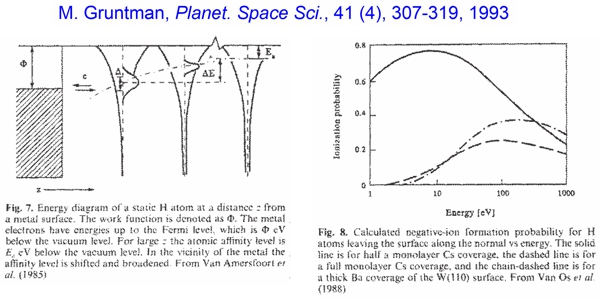
Fig. 7. Energy diagram of a static H atom at a distance z from a metal surface. The work function is denoted as Φ. The metal electrons have energies up to the Fermi level, which is Φ eV below the vacuum level. For large z the atomic affinity level is E_a eV below the vacuum level. In the vicinity of the metal the affinity level is shifted and broadened. From Van Amersfoort et al. (1985).
Fig. 8. Calculated negative-ion formation probability for H atoms leaving the surface along the normal vs energy. The solid line is for half a monolayer Cs coverage, the dashed line is for a full monolayer Cs coverage, and the chain-dashed line is for a thick Ba coverage of the W(110) surface. From Van Os et al. (1988).
Knowing the electron transition frequency, it is possible to calculate the equilibrium probability for the atom to be negatively charged at a certain distance from the surface. Introducing further the motion of the atom (described classically) and integrating the rate equation, one can determine the probability that the atom leaves the surface as a negative ion. The charge transfer probability depends on both components of the atom velocity, parallel and perpendicular to the surface. The typical velocity of interstellar atoms is much smaller than the electron velocities in conversion surfaces, and therefore the charge transfer probability is determined mostly by the atom velocity component normal to the surface (Van Wunnik et al., 1983a). The highest conversion efficiencies are characteristic of surfaces with a low work function and a high density of electron states at the Fermi level. The most developed and well studied conversion surfaces are metals covered by alkali layers, e.g. by Cs, which provide the highest values of conversion efficiency. As an example, the calculated dependence (supported by the experimental data) of negative H ion formation for three different surfaces on normal energy is shown in Fig. 8 (Van Os et al., 1988). Let
Let us assume that the interstellar H (or D) atom's normal velocity is 35 km s^(_1), which corresponds to a 45° angle of incidence on the conversion surface for an atom with the total velocity of 50 km s^(-1). Such velocity is typical for interstellar H atoms at the Earth's orbit (Fig. 2). Then the fraction of negative ions in the particles reflected from the W surface W( 100) covered by a thick layer of Cs, is 5-7% (Fig. 8). A very thin Cs layer (half a monolayer) may give a much higher negative ion fraction (Van Wunnik et al., 1983a). However, there are difficulties in maintaining such a surface in a space instrument, so the use of a thick Cs layer may be preferable. An overall conversion coefficient of several percent (Schneider et al., 1981; Van Wunnik et al., 1983b; Van Os et al., 1988) could be expected for interstellar H and D atoms.
The work function of the surface is very sensitive to the degree of coverage by Cs. For example, a detailed study of an n-type (100) Si substrate shows that a clean surface has a work function 4.75 eV, while the work function of a surface covered by a monolayer of Cs is 2.00 eV, and for a surface covered by a half of a monolayer of Cs is 1.47 eV (Souzis et al., 1989). Controlled oxidation of Cs may lead to further lowering of the work function down to 0.9 eV. For thick layers of Cs oxides, which means that a substrate may not be crucial, work functions of the order of 1 eV have been reported (Souzis et al., 1989 ; Melnychuk and Seidl, 1991). Sputtering and implantation processes are unimportant for a bombardment by low energy neutral atoms, as in our case (Fig. 3), and complex multi-component converters such as cesium oxides — a mixture of Cs/Cs2O/Cs2O2 — can be used. Such promising surfaces can be several hundred angstroms thick: their work functions are independent of the substrate compositions, and the cesium oxides have a vapor pressure much lower than pure cesium (Melnychuk and Seidl, 1991). An exposure of oxygenated Cs surfaces to large fluxes of H may result in some change, about ±0.1 eV, of work function (Souzis et al, 1989).
The photoemission properties of the conversion surface would depend strongly on its work function. Hence, the measurement of photoelectron flux from such a surface is a direct way to determine the value of the work function when the photon flux and its spectral distribution are known. Such measurements could be used in the flight instrument to monitor conditions on the converter surface, as is shown in Fig. 6. Cesiated surfaces, though providing high conversion efficiencies, are not easy to maintain. For example, Cs has a high vapor pressure which could lead to contamination of the instrument. Metal surfaces covered by layers of alkalis other than Cs, such as Na (Schneider et al., 1983) or Rb and K (Schneider et al., 1981) can also be used for conversion of H atoms.
During the last several years, a lot of attention was devoted to Ba surfaces (e.g. Van Os et al., 1987, 1988; Kleyn, 1990), which may also provide high conversion efficiencies. Ba is a much more stable and convenient material to use although initial activation-by heating up to 1200 K (Melnychuk and Seidl, 1991) or by sputtering of several surface atomic layers — is needed to eliminate the oxide layer and provide a metal-type surface. An interesting possibility is to use the ambient space plasma (e.g. solar wind plasma) to sputter the conversion surface: plasma ions could be sucked in. focused and accelerated for such a purpose. The low density of the solar wind plasma may require a couple of days of sputtering to accumulate the necessary dose. Another possible surface under study is LaB6, (e.g. Kleyn, 1990) which also requires heating to a temperature of 1400 K to activate such a conversion surface. Different metals, such as W and MO (e.g. Van Bommel et al., 1984) as well as Mg, Cu, Au and Pt also may serve as a conversion surface, although the typical conversion efficiencies are usually very low: 10(-4)-10^(-6), which prohibits their use for the ISG detection. Certainly the selection of the type of conversion surface and a way to activate and control it, as well as the stability of the surface and the necessity to refresh (and/or to activate) it during a long duration space flight require further detailed study. However, one may safely assume as a conservative estimate the value of ε_H = 0.01 for the conversion coefficient for interstellar H and D atoms. A similar value of the conversion efficiency can be expected for O atoms.
The process of the conversion of neutrals to negative ions on surfaces has an energy (normal component) threshold equal to the difference between the surface work function and electron affinity of the particle. Electron affinities of some atoms and molecules that may be of interest for space applications, as well as work functions of surfaces on which conversion into negative ions has been studied experimentally, are presented in Tables 2 and 3, respectively. One can see that conversions of only a few species (marked by an asterisk) have been studied experimentally. It is important to emphasize that only the conversion of H and D atoms [and to some extent, O atoms (Van Pixteren et al., 1989)] has been studied extensively. Although surface production of negative ions is qualitatively understood, quantitative agreement between theory and experiment has been achieved by adjusting some parameter (usually screening distance). Consequently, one has to be cautious in making specific numerical predictions of energy thresholds and conversion probabilities without experimental backing.
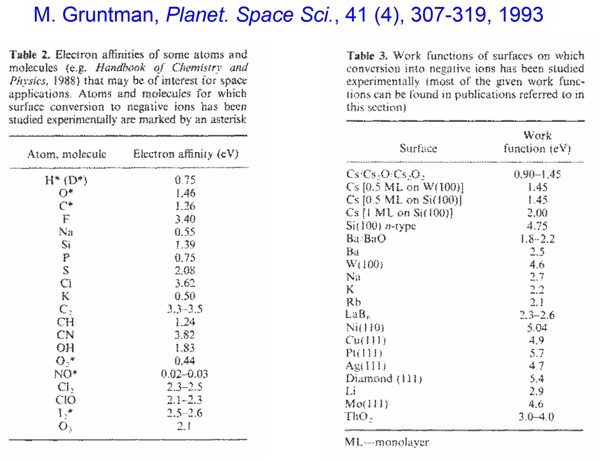
Table 2. Electron affinities of some atoms and molecules (e.g. Handbook of Chemistry and Physics, 1988) that may be of interest for space applications. Atoms and molecules for which surface conversion to negative ions has been studied experimentally are marked by an asterisk.
Table 3. Work functions of surfaces on which conversion into negative ions has been studied experimentally (most of the given work functions can be found in publications referred to in this section).
A potential problem with surface conversion that should be kept in mind is the possibility of producing negative ions by sputtering previously adsorbed atoms and molecules from the surface. Energetic ions with energy higher than, say, 100-200 keV (flux ≥ 1 cm(-2) s^(-1) sr^(-1)) at 1 a.u. from the Sun), would pass the deflection system at the entrance of the instrument and would hit the conversion surface, sputtering negative ions. In our case, the adsorption of interstellar atoms on the conversion surface does not pose a problem at all. Even for the most intense expected flux of interstellar H, it would take 15 years to cover 1% of the sensitive surface by H providing each impinging atom is adsorbed. Most of the contamination danger may come from the adsorption of atoms and molecules outgassed from the instrument elements and the spacecraft itself. Therefore a special effort should be devoted to maintaining a clean conversion surface in the instrument.
Selection of the conversion surface should be determined by the specific requirements of the space experiment. For detection of a minor ISG constituent such as D, one has to maximize the conversion efficiency and a metal covered by a submonolayer of Cs seems to be preferable. Periodic refreshing of a cesiated surface can be easily realized by using a small emitter of Cs atoms. Although Ba surfaces also show high conversion efficiencies, their activation may require power-consuming solutions which would be prohibitive for small instruments typical of the future deep space missions. If the emphasis is on the study of a much more abundant species such as H atoms, then less demanding (in maintenance) surfaces such as a multicomponent mixture of Cs oxides or lanthanum hexaboride (LaB6) look promising. For the measurement of O atoms and molecules in a low-Earth orbit, which is discussed further in the section on other applications, the use of a pure Au surface may be justified when no high conversion efficiency is required. A focused laboratory study of the conversion processes as well as a study of the technical problems of activating, maintaining and refreshing the surfaces in space should provide a guide in the future for the selection of optimal surfaces for various experiments.
Instrument characteristics and expected count rates
For the detection of the cold neutral gas. the negative ion count rate, N_i,, by the proposed technique is equal to:
N_i = n_p × V_REL × S_d × ε_c × η_T × ε_d ,
where n_p is the local neutral particle number density; V_REL is the spacecraft velocity relative to the neutral gas; S_d is the instrument effective sensitive area; ε_c is the conversion efficiency; η_T is the efficiency of negative ion collection and transmission through the magnetic analyzer; and ε_d is the detection efficiency by the detection section (TOF unit) of the instrument. Instrument parameters may vary widely and for example, for such realistic values as V_REL = 50 km s^(-1), S_d =1 cm^2; ε_c = 10^(-2); η_T = 0.5 and ε_d = 10^(-2), one obtains a sensitivity N_i/n_p = 2.5×10^3 (count s^(-1)/(particle cm^(-3)). The measured signal is proportional to the flux of particles into the instrument, and, depending on species and experimental conditions, typically such high values of sensitivity as 10^(-4)-10^4 (count s^(-1)/(particle cm^(-3)) can be achieved.
The efficiency of negative ion collection and transmission through the magnetic analyzer, η_T, would depend on the characteristics of the fluxes to be studied and on the instrument design. One can expect that by optimizing the shape of the conversion surface a large fraction of the negative ions would be directed toward the entrance of the magnetic analyzer. The initial energy of negative ions is small (e.g. about 50 eV for interstellar D; Fig. 3) and their subsequent acceleration up to 10-16 keV should allow efficient ion focusing. In addition, a magnetic analyzer is required to distinguish only a few interstellar atoms (H, D. and O) and its mass resolution can be correspondingly low. Hence, the wide range of angles of entrance into the magnetic analyzer would be acceptable for transport of ions to the TOF section, especially if the magnetic field is optimized to provide ion focusing on the exit slit. A combination of all mentioned factors could result in a rather high "collection" efficiency of negative ions.
Let us assume that the field of view of the instrument to measure the ISG is 15°×15°. This allows the instrument to intercept all the flux of D or O atoms and a substantial part of the H atom flux. For the parameters of the instrument given above, the overall efficiency of the instrument, ε_c×η_T×ε_d to detect individual atoms would be 5×10^(-4).
This value of the detection efficiency would then result in typical count rates of I_H = 2.5 s^(-1), I_D = 1.5×10^(-4) s^(-1), and I_O = 3×10^(-2) s^(-1) for interstellar H, D and O atoms, respectively. Let us assume that the noise count rate of the detectors is as high as 10^2 s^(-1). Then, for triple coincidences in the TOF section, the random count rate would be less than 10^(-9) s^(-1) and fluxes of all these interstellar atoms could be reliably measured. Even for the worst case of D atom detection, one could expect a count rate as much as 15 count day^(-1) without noise. Even a tiny fraction of negative H ions somehow reaching the TOF section, say, by scattering from surfaces of construction elements within the instrument, may pose a danger to and "contaminate" the measurements of D atoms. However, one could expect that D ions would be concentrated within a range of a few nanoseconds on the TOF spectrum whereas scattered H ions/atoms would have a very broad energy distribution and correspondingly, a broad range of times of flight. This sharp time signature as well as a proper design of baffles and stray particle traps within the instrument should allow a reliable detection of D ions. Detection of H2 molecules is also possible by the proposed technique. Bombardment of the conversion surface by H2 molecules would result in a production of atomic H negative ions that are indistinguishable from those due to atomic H flux. The H2 molecules flux could be distinguished from atomic H flux because of the difference (about 15°) in the angles of their arrival at the observation point (Fig. 4). Obviously the detection of the H2 molecule flux can be achieved only if the flux of molecules is comparable to that of atoms and the instrument field of view is somewhat smaller than the difference in angles of arrivals of atomic and molecular particles.
A proper design of the instrument could allow one to increase substantially the instrument geometrical throughput. The latter should facilitate measurements of interstellar D. One of the possible ways to do it can be based on a "grazing-incidence telescope"-like configuration with an enhanced sensitive surface area (e.g. Fig. 8 in Hsieh and Gruntman, 1993 [pdf]). The atoms would be converted to negative ions at the first grazing incidence collision with the telescope's "mirror" and directed toward the analyzer entrance for subsequent acceleration, analysis and detection by the ion analyzer. Such a configuration should provide high geometrical throughput of the instrument due to the "focusing" effect of the conversion surfaces.
The expected dynamic characteristics of fluxes of interstellar atoms at the Earth's orbit and the possibility of noise-free registration and identification of atoms should allow us to determine unambiguously for the first time the composition (including minor, but very important, constituents) of the ISG in the LISM.
Other possible applications
The suggested technique should allow a direct detection of dilute neutral gases in space. In many cases, neutral particle populations remain poorly explored experimentally, though they contain a wealth of scientific information (Gruntman, 1991, 1992 [pdf], 1993a [pdf]; Gruntman et al., 1991 [pdf]; Williams at al., 1992 and references therein; Hsieh et al., 1992). The technique can be used to measure all those atoms and molecules that have a positive electron affinity. The number of atoms and molecules that could, in principle, be detected by the technique makes its application unusually broad. Conversion to negative ions on surfaces has been observed experimentally for such species as H, D, C, O, O2. The conversion of other species, such as Na, K, Si, S, Cl, OH, O3, etc., which may be of interest for the study of tenuous atmospheres of celestial bodies, has yet to be demonstrated. There is a velocity (energy) threshold for detection of some atoms and molecules. For example, for atomic H it is ≈10 km s^(-1). Development of the technology should allow one to reduce, if not eliminate, such a threshold.
A number of potential applications of the technique can be identified presently.
Sun's vicinity
Two populations of hydrogen atoms in the Sun's vicinity are of prime interest: the neutral component of the expanding solar corona and dust-deionized atoms (Banks, 1971; Holzer, 1977; Fahr et al., 1981). Their study can give additional insight into a number of fundamental problems like the heating of the solar corona and the acceleration of the solar wind, as well as the fate of the interplanetary dust grains. This region will be visited in the future by the Solar Probe (Space Physics Missions Handbook, 1991). The principal difficulty in neutral atom measurements identified so far is a cloud of C atoms evaporating from the Solar Probe spacecraft protective shield. Solar wind protons may charge exchange with these carbon atoms, creating a flux of neutral H atoms which would enter the instrument. Estimates show that this background would be dominant at the trajectory perihelion for currently assumed shield characteristics (unpublished, Gruntman, 1991). Evaporation of the C is a function of the shield temperature and the measurements are possible at somewhat larger distances (> 0.05-0.1 a.u.) from the Sun.
Environment of the planets, their moons, comets and asteroids
A neutral particle mass spectrometer based on the conversion of atoms and molecules to negative ions can be used to study upper atmospheres and exospheres of planets at the altitudes where the conventional technique does not have enough sensitivity. Besides H, its isotopes and O atoms, there are other atoms, such as C, F, Na, Si, P, S and Cl, that present interest for the study of the environments of planets, the Moon, comets and asteroids which can be detected by the proposed technique (see Table 2). An interesting possibility is to try to convert molecules important for atmospheric chemistry, such as OH, CH, Cl2, ClO and O3, to negative ions. The conversion of low-energy atoms with energies of a fraction of an electronvolt has not been studied as extensively as for higher energies (see e.g. Seidl et al., 1989). The situation is more complicated for molecules, which may dissociate at the surface impact (e.g. Kleyn, 1992). Experimental data on conversion of molecules to negative ions are scarce and adequate theoretical models have yet to be built. Direct, in situ measurements of tenuous atmospheres may help to solve a number of outstanding problems. One of the examples is the lunar atmosphere where currently available experimental data cannot be explained by the existing models (Morgan and Shemansky, 1991). Another example is the study of atmospheres of the outer planets (Shemansky and Hall, 1992) and neutral particle environment of primordial bodies in the Solar System such as asteroids and comets.
Earth. For the Earth, the velocity of a spacecraft at low Earth orbit is about 7 km s^(-1) and it corresponds to an energy of 0.25 eV nucleon^(-1). The conversion process has an energy threshold for cold conversion surfaces which is equal to the difference between the work function of the surface and the affinity energy of the atom. Conversion surfaces with work functions as low as 0.9 eV have been reported and work function of the order of 1 eV has been obtained for stable surfaces (Souzis et al., 1989; Melnychuk and Seidl, 1991). The heating of the converter would result in the lowering of the effective energy threshold although the conversion efficiency would also be low. It should be noted that even relatively low conversion efficiencies in the range of 10^(-3)-10^(-6) would provide sensitivity, which is much higher than in conventional mass spectrometers. It is still unclear whether it is possible to apply the technique for the detection of atomic H in the terrestrial atmosphere and exosphere and this question requires further detailed study. As far as heavier atoms are concerned, for example atomic O, there is no doubt that they can be efficiently detected.
A wide variety of spacecraft orbiting the Earth at relatively low altitudes are subject to the effects of surrounding atomic O. For example, at an altitude of 500 km, a typical O number density is 10^7 cm^(-3) (Chamberlain, 1978). Atomic O is highly reactive and causes unwanted effects on exposed optical surfaces, solar cells and space hardware. Shuttle glow is one of the most dramatic manifestations of the interaction with O flux. Knowledge of the space O environment becomes even more important with the deployment of long duration space structures such as the space station Freedom. Measurement of O atom number density by conventional techniques is inherently ambiguous if O2 molecules are also present. Let us note that O energies relative to the spacecraft are 5 and 10 eV for atoms and molecules correspondingly. If one uses for conversion a surface with a rather large work function, such as Au (work function 5.1 eV) or Pt (5.65 eV), then one can differentiate atomic and molecular particles. O atom energy is higher than the conversion threshold, and such atoms can be converted on a Au surface into O- negative ions. In order to produce O- ions when an O2 molecule hits the surface, the molecule has to dissociate and a fragment particle should leave the surface as O-. The energy necessary to dissociate molecular oxygen is 5.1 eV. If one assumes that dissociation energy is coming from the kinetic energy of the molecule and the remaining kinetic energy is equally divided between two fragments, then, as one can see, the energy of O atoms is not sufficient to leave the conversion surface as O-. Therefore, one can expect that O- ions are produced due to atomic O flux only and the signal is not contaminated by the presence of the molecular O. The interaction of molecules with surfaces is complicated and is not adequately understood, so a special feasibility study of such oxygen selective detection is required.
Moon. The orbital velocity around the Moon is 1.7 km s^(-1), which corresponds to an energy of 0.014 eV nucleon^(-1). As far as the detection of H atoms is concerned, the difficulties are even greater than for the low Earth orbit. The heavier atoms, such as O, Si, Na and K can be detected. Incidentally another novel in situ detection technique can be used for measuring Na and K atoms in the lunar environment (Gruntman, 1993b). This technique, which is specific to the in situ detection of alkali atoms, is based on atom ionization on hot surfaces.
Giant planets. The proposed technique can definitely be used for the study of giant planets. For example, an orbital velocity around Jupiter corresponds to an energy of almost 10 eV nucleon^(-1) and many atoms and molecules with such energy can be efficiently converted to negative ions.
Primordial bodies. A spacecraft flyby velocity relative to an asteroid or a comet would vary widely from a few km s^(-1) up to 70 km s^(-1). Under such conditions, tenuous neutral particle environments could be efficiently studied.
Heliospheric energetic neutral atoms
The interaction (charge exchange process) of interstellar gas with the solar wind in the heliospheric interface region produces the flux of heliospheric energetic neutral H atoms (HELENAs). Experimental study of HELENAs would provide an opportunity to remotely study a morphology of the heliospheric boundary and physical processes in the heliospheric interface. The energy of such H atoms is in the range of 100-800 eV and the expected flux is highly anisotropic with an intensity of 3×10^2 cm^(-2) s^(-1) sr^(-1) coming from the upwind direction (Gruntman, 1992 [pdf]). HELENAs can be detected rather efficiently by their conversion into negative ions. An instrument similar to a grazing-incidence telescope could provide the rather large sensitive surface area required to detect a low intensity flux. The HELENAs would be converted to negative H ions at the first grazing-incidence collision with the telescope's "mirror" and subsequently collected, analyzed and detected by the ion analyzer (see Fig. 8 in Hsieh and Gruntman, 1993 [pdf]).
Magnetospheric energetic neutral atoms
Magnetized plasmas in planetary magnetospheres emit magnetospheric energetic neutral atoms (ENAs) when energetic plasma ions undergo a charge exchange interaction with background gas atoms. The measurement of ENAs is recognized as a powerful tool in the study of global processes in planetary magnetospheres (e.g. Williams et al., 1992). Development of the instrumentation for magnetosphere imaging in ENA fluxes has concentrated so far on the detection and identification of neutral particles with energies higher than a few keV (McEntire and Mitchell, 1989; McComas et al., 1991; Hsieh et al., 1992). Development of the technique proposed here would allow the energy threshold to be lowered down to 10 eV. It would consequently make it possible to experimentally study much cooler plasmas, as well as plasma flows in the ionosphere.
Small comets
The existence of a large population of small, 10×10×10 m, fluffy snow comets in the solar system was suggested by Frank et al., (1986). This controversial issue was recently reviewed by Dessler (1992) and it continues to attract substantial attention in the space community. Even if these comets are several orders of magnitude less numerous than was suggested originally by Frank et a1. (1986), they still would play a fundamental role in the solar system. The technique proposed here would provide a unique opportunity to directly investigate this hypothesis. Vaporization of the water snow comets becomes substantial at heliocentric distances less than 2.5 a.u. (Frank et al., 1986) and the lifetime of H and O atoms is about 1 month at 1 a.u. from the Sun. If in situ measurements of the neutral H and O atoms reveal number densities higher than expected for the ISG, then such excessive neutral particle population could be attributed to the presence of small comets. Moreover, measurement of the kinematic characteristics of neutral atoms should provide an insight into comet trajectories. The presence of comets should also manifest itself by the locally increased neutral atom number densities due to comets flying by at a certain distance from the spacecraft which would be naturally detected by the proposed technique.
Conclusions
A novel, unconventional experimental technique, described in this paper, can provide new capabilities in space instrumentation which are not currently available. Direct, in situ detection of neutral atoms in space plasma could be achieved with exceptionally high sensitivity. The application of such a technique to the study of the interstellar gas would lead to direct, in situ measurement of interstellar H, D and O atoms. A study of the differences in kinematic parameters of different interstellar species is important for understanding the penetration of interstellar neutral atoms. Such measurements, being complementary to the Ulysses GAS experiment (Witte et al., 1992) where interstellar He atoms were directly measured, should provide the basis for a comprehensive study of the LISM, its interaction with the Solar System and formation of the heliosphere.
The proposed instrumental arrangement would provide direct unambiguous determination of particle masses. Instrument design for the study of interstellar gas would depend on the emphasis of the experiment. If the measurement of D is the focus of such a mission, then a wide field of view instrument with large geometrical throughput would be used. Accurate measurement of the velocity distribution function of interstellar H atoms would require a narrow field of view instrument capable of scanning the sky, as was done by the Ulysses GAS instrument.
Although the focus of this paper is a direct study of the composition of the ISG, obviously the suggested technique has much wider application, making it a truly multidisciplinary tool. A number of other possible applications has been identified, among them the direct study of tenuous exospheres of planets, comets and asteroids; monitoring of atomic and molecular oxygen at the low Earth orbit; and direct detection of the ultra-low energy (10-500 eV) energetic neutral atoms (ENAs) which are of interest for heliospheric, magnetospheric and ionospheric imaging. The technique, when fully developed, should provide an efficient and versatile tool for unusually wide application in the study of neutral atoms and molecules in space.
Acknowledgement
During the last 2 years, I have enjoyed the opportunity of discussing different aspects of the ideas presented above with many colleagues whose genuine interest, support and encouragement are greatly appreciated by me. My special thanks are to Ara Chutjian, Tony Donné, Hans Fahr, Priscilla Frisch, Bruce Goldstein, Stan Grzedzielski, Tom Holzer, Johnny Hsieh, Darrell Judge, Dick Mewaldt, Ron Van Os, Helmut Rosenbauer, Milos Seidl, Don Shemansky, and Bruce Tsurutani. Thus work was supported partially by NASA grant NAG 2-146.
References
See article pdf
|
160+ problems with detailed solutions
|
 |
|
|
|
|