 –
Mike's books
–
Mike's books
astronauticsnow.com/ssh/
Mike's space and rocket videos –
–
Mike's books
Saryshagan missile defense test site, USSR
First ballistic missile (IRBM) intercept
Saryshagan missile defense test site, USSR


First IRBM intercept on March 4, 1961
The Soviet Union accomplished the first "nonnuclear" intercept of a ballistic missile (IRBM) warhead by a missile at the Saryshagan missile defense test range in Kazakhstan on 4 March 1961. Grigorii V. Kisun'ko (Kisunko) led the team.
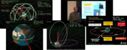
Pages 407 and 408 from M. Gruntman's Blazing the Trail show the arrangements of this ballistic missile interceptt.
A recently published "Intercept 1961. The Birth of Soviet Missile Defense," AIAA, 2015 details this technical achievement, describes the program development (including preceding emergence of air defense systems SA-1 and SA-2), and provides the historic and technological background and context.
Detailed table of content of Intercept 1961
|
|
|
|||
Intercept 1961:
From Air Defense SA-1 to Missile Defense System A
Proceedings of the IEEE, v. 104, issue 4, 883-890, 2016
I. INTRODUCTION
On March 4, 1961, a Soviet guided missile intercepted and destroyed the approaching warhead of an intermediate-range ballistic missile (IRBM) SS-4 (R-12) at the Saryshagan test site in the Kazakhstan desert. Several successful intercepts followed, paving the way for the emergence of a powerful political, military, scientific–technological, and industrial missile defense complex in the Soviet Union. A new chapter in the eternal competition between protecting and avenging, between the sword and the shield, has begun.
The spectacular nonnuclear destruction of a long-range ballistic missile clearly earned a place among the most important and consequential Soviet firsts — on par with the first intercontinental ballistic missile (ICBM) SS-6 (R-7) and artificial satellite Sputnik in 1957 and the first cosmonaut in 1961—in a rapidly advancing field of missiles and space. The intercept stood out as especially impressive because it relied on advanced electronics, sophisticated radar, high-speed communications, real-time digital computing, and precise guidance and control.
The development culminated in deployment of the operational missile defense system A-35 (early 1970s) and its successors protecting the Soviet capital Moscow. The missile defense program also led to optical and radar monitoring of orbiting space objects; early warning of ballistic missile attack by sensors on satellites and by above-the-horizon and over-the-horizon radar; penetration aids for strategic ballistic missiles; antisatellite weapons; and space-based weapon systems.
The missile defense achievement had its roots in Soviet air defense that was organizationally and technologically different and separate from the establishment building strategic ballistic missiles and satellites and launching cosmonauts. All these advances in Soviet weapons played a major role in shaping U.S. defense programs and technologies during the Cold War.
The article tells a little known story, based on a recently published book [1 (website)] and Russian literature [2], [10]–[17], of the first antiaircraft system SA-1 in the Soviet Union, the first intercept of an IRBM, and emergence of missile defense.
II. FROM ANTISHIP MISSILE TO AIR DEFENSE SYSTEM SA-1
While recovering from the devastation of World War II, the Union of Soviet Socialist Republics (USSR) poured enormous resources into the development of nuclear weapons, ballistic and guided missiles, jet aviation, air defense, and electronics. Lavrentii Beria, former head of secret service and trusted henchman of Soviet dictator Joseph Stalin, directed this vast program. The government opened new research institutes, design bureaus, and production facilities. On September 8, 1947, Stalin signed a decree setting up a new Special Bureau No.1 (Russian abbreviation SB-1) to develop an air-launched antiship missile, codenamed Kometa (a comet). The 23-year old son of feared Beria, Sergo, became chief engineer of SB-1 and an experienced radio engineer, Pavel N. Kuksenko, its director.
A Tu-4 bomber (known in the West as Bull) released a Kometa missile at an altitude 3–4 km and 100 km away from the target ship. The onboard operator first guided it to the target continuously illuminated by the airplane radar (similar to U.S. AN/APQ-13) at the 10-GHz frequency. At distances of 16 km from the ship, the missile sensor picked up reflected radar signals and homed in on the illuminated target autonomously. In the final test in 1952, the fully armed Kometa sunk a cruiser. By that time SB-1 had already engaged in a much bigger effort.
The Cold War tensions had been increasing in the late 1940s. In August 1950, Stalin gave Kuksenko a new challenging task of building an "impenetrable" air defense system for the Soviet capital Moscow against a massive raid of 1000 bombers from all directions. One enemy aircraft breaking through with an atomic bomb onboard was too many. The government named the program Berkut (a golden eagle). Minister of Armaments Dmitrii F. Ustinov reorganized SB-1 into Design Bureau No. 1 (KB-1). (Ustinov played a major role in overseeing Soviet defense industry, including air and missile defense, from 1940s until his death in 1984.) Kuksenko and Sergo Beria became chief designers of this national top-priority program, in addition to directing Kometa.
A sequence of state committees on radioelectronics took over and would direct research and development in radar and air defense and later missile defense, to be eventually reorganized into a Ministry of Radio Industry. At the same time, a Ministry of General Machine Building oversaw ballistic missiles and space establishments. These two major parts of defense industry were also supported by separate procuring entities in the Ministry of Defense.
The unprecedented challenge of Berkut called for significant advances in many areas of science, engineering, and industrial production. KB-1 rapidly grew and took over many specialists from other institutes, bureaus, and plants, including a radar specialist, Alexander A. Raspletin, and a rising science star, Grigorii V. Kisun'ko [3]. Raspletin assumed responsibilities of deputy chief designer of Berkut. Kisun'ko who had recently authored a monograph on microwave waveguides (to this day referred to in Russian publications) would later lead the missile defense effort.
A concept of aircraft missile intercepts originated from German work on air defense during World War II. It relied on two narrow "pencil-beam" radars, one continuously tracking an aerial target and the other tracking and guiding the antiaircraft missile. This approach would have required a prohibitively cumbersome and expensive system of 1000 antiaircraft sites, with two radars at each, for Berkut. The emerging digital computing provided essentially new possibilities.
In the late 1950, Raspletin devised an alternative radar concept with two separate mechanically scanning narrow fan beams. One radar unit determined only the vertical (elevation) angular coordinate of a target and the other only the horizontal (azimuth) coordinate. The approach relied on storing positions of multiple targets in a computing device memory while periodically scanning a wide sector and updating their coordinates. Raspletin's new "track-while-scan" radar, designated B-200, could simultaneously follow 20 airplanes as well as intercepting antiaircraft missiles. Now, the entire Berkut system could be realistically based on 50–60 radar units.
Stalin died in March 1953. Five months later, the military operationally deployed KB-1's Kometa antiship missiles, known in the West as AS-1 and Kennel. By that time the government had demoted Kuksenko and appointed Raspletin the sole chief designer of the S-25 system, the renamed Berkut. The once omnipotent elder Beria and his son Sergo were arrested, awaiting execution and banishment, respectively, in the internal Kremlin struggle for power. Nikita S. Khrushchev would ultimately emerge as the leader of the Soviet Union and a champion of ballistic missiles, space, and air and missile defense.
By October 1955, the CIA analysts had reconstructed the S-25 concept and concluded that the Soviets had made a "clean break" from "the original German wartime development of surface-to-air missile guidance" and "postwar Western efforts" and "arrived at a design that was inherently capable of dealing with multiple targets simultaneously." They called the implications of the new approach "startling" [4].
Both units of the B-200 radar (nicknamed by the CIA "Yo-Yo") consisted of two large parallel triangular structures, turned at a 60° angle to each other (Fig. 1). Three sides of each triangle served as antenna apertures, producing a 1°×60° beam. The entire structure rotated about the axis normal to the plane of the triangles, and the transmitter commutated sequentially to one of the six antennas. Thus, the fan beam swept through the 60° sector six times during each full rotation of the triangle pair. The radar operated at the 3-GHz frequency, rotated at the rate of 50 r/min, with beams sweeping the defended sector five times each second.
Fig. 1 (see article pdf). Track-while-scan B-200 (Yo-Yo) radar (top) with heights of the azimuth (middle) and elevation (bottom) units 8 and 9 m, respectively. Photographs from [5].
The S-25 system also included ten A-100 early warning radars, operating at the 3-GHz frequency and deployed at distances of 200–250 km from Moscow. Then, two rings of 32 and 24 air defense sites circled the city at distances of 90 and 45 km, respectively (Fig. 2). Each site housed an air defense regiment with a track-while-scan B-200 radar and launch positions for 60 subsonic single-stage liquid-propellant antiaircraft missiles V-300 developed by the design bureau of Semen A. Lavochkin. The S-25 air defense sites and its missiles became known as SA-1 or Guild in the West.
Fig. 2 (see article pdf). CIA map of two rings of air defense sites circling Moscow compiled in November 1959 before the advent of space reconnaissance. It shows 22 and 34 sites in the inner and outer rings, respectively, instead of the correct 24 and 32 sites. Figure from [6].
The completed system became operational in 1955 and stood on duty until 1984. It could simultaneously engage up to 1120 aerial targets (20 by each site) at distances of 35–45 km and altitudes of 3–25 km. Operational missiles demonstrated miss distances better than 50 m in intercepts. One missile variant could carry an atomic warhead for interception (demonstrated in a live test with a 10-kton warhead on January 19, 1957) of a tight formation of approaching airplanes.
The first unexpected test of the new air defense took place on July 5, 1956, when a U.S. U-2 reconnaissance plane flew over Moscow. The S-25 failed to engage and stop it. By this time the work on missile defense had begun.
III. BEGINNING OF MISSILE DEFENSE
During World War II the German army operationally launched 3000 of the A-4 (V-2) ballistic missiles against London, Antwerp, and other Allied targets. Although radar detected the rocket, nothing could stop it. Coupled with the emerging atomic weapons, such long-range ballistic missiles presented an existential threat, and visionary American and Soviet officers and scientists began to explore possible defenses [1 (website)].
In August 1953, Chief of the General Staff of the Soviet Army Marshal Vasilii D. Sokolovsky and six other marshals sent a letter to the Central Committee of the Communist Party of the Soviet Union urging development of antiballistic missile capabilities. The Soviet military doctrine would later combine strategic offense and defense, with the latter emphasizing protection against missiles [7].
At that time in 1953 missile defense looked impossible to many. The S-25 missiles just scored the very first successful intercepts of aerial targets at a test range. Effective radar cross sections of warheads were 100 times smaller than those of typical aircraft and they flew at velocities up to 20 times faster than contemporary planes. The intercept would last only a few minutes from the warhead detection. Therefore, antimissile missiles had to be launched on short notice in a highly automated, computer-controlled process with precision, speed, and guidance accuracy far beyond the state of the art. At that time, electronics relied almost exclusively on vacuum tubes; digital computing was still in its infancy.
Leading Soviet defense specialists evaluated the letter of the influential marshals in September 1953. At the meeting, the S-25 chief designer Raspletin called the proposal "unfathomable fantasy." Then, a leading radio scientist and director of the Radiotechnical Laboratory of the USSR Academy of Sciences (RALAN, renamed Radiotechnical Institute, or RTI, in 1957) Alexander L. Mints characterized it as "such a stupidity as shooting an [artillery] projectile at another projectile." In contrast, KB-1's Kisun'ko brought to the discussion specific scientific and engineering details of the challenge and argued that the necessary advancements were achievable (Fig. 3).
Fig. 3 (see article pdf). Leaders of development of early Soviet air and missile defenses: Alexander Raspletin (left), Alexander Mints (middle), and Grigorii Kisun'ko (right). Photographs courtesy of ITAR-TASS (left and right) and A.L. Mints Radiotechnical Institute (middle).
Highest government awards for the S-25 development identified Raspletin and Kisun'ko as the two leading specialists in the powerful KB-1. Only they were in a position to spearhead the missile defense effort. Raspletin chose to concentrate on perfecting air defenses. The government soon authorized development of his new antiaircraft system S-75, known in the West as SA-2 and Guideline. Later these S-75 missiles brought down U-2 planes over the Soviet Union in 1960 and over Cuba and People's Republic of China in 1962. They also engaged in an air war in Vietnam in 1960s. Under Raspletin, who had died in 1967, and his successors, KB-1 (known later as Almaz, now part of Almaz- Antei) produced many air defense systems, including S-125 (SA-3), S-200 (SA-5), S-300 (SA-10, SA-20), S-400 (SA-21), and today’s S-500.
Head of a leading technical department in KB-1 Kisun'ko strived for independence. Boiling with energy, he jumped on the emerging missile defense opportunity. This endeavor required the talents of both a scientist and a manager, a combination that he possessed. In February 1956, the government authorized development of the experimental System A, proposed by Kisun'ko for missile defense of Moscow, and its demonstration at a new test range. By that time Kisun'ko had directed a semi-independent Special Design Bureau SKB-30 (then renamed OKB-30) carved for him within KB-1. Later he would completely separate from the parent organization focused under Raspletin primarily on air defense.
With powerful officials backing their favorite chief designers, the government also supported further study of an alternative missile defense concept advanced by influential Mints. His RTI institute would become a main participant and perennial competitor and rival of Kisun’ko in missile defense. Many other organizations joined the lavishly funded effort that expanded into early warning of ballistic missile attack, above-the-horizon and over-the-horizon radar, space situational awareness, and antisatellite weapons.
System A of Kisun'ko had to demonstrate defense against one ballistic target, a pair consisting of a warhead and the separated accompanying body of the rocket. The system included a long-range search and acquisition radar Dunai-2 (the Danube) to detect the incoming missile. Then three precise tracking and guidance radars (RTNs) tracked the approaching warhead and guided the intercepting missile toward it. The widely separated RTNs formed an equilateral triangle, accurately measured their distances to the target, and determined its absolute position by the method of three respective distances. The interceptor missile exploded its fragmentation warhead, destroying the target. Kisun'ko planned to place three RTN radars of the envisioned operational missile defense system at the existing outerring S-25 sites around Moscow (Fig. 2). This design determined the 150-km distances between the RTNs.
The Ministry of Defense selected a desolate area in the Betpak Dala desert west of the Balkhash (Balqash) lake in Kazakhstan as a new State Scientific-Research Test Range N.10 (GNIIP-10) for System A. A small settlement with a railroad station, Saryshagan, near the lake’s shore became the jumping off point for building the new installation. It also gave the informal name to GNIIP-10, the Saryshagan Test Range, that stretched 250 km from north to south and 600 km from east to west. There were more than 250 sunny days each year and a harsh desert climate with extreme air temperature variations, little precipitation, strong gusts of wind, and occasional sand storms.
The military rushed many thousands of constructions troops to the location to build numerous technical positions, infrastructure, and living quarters. By 1964, the main residential area on the lakeshore, town Priozersk, had more than 25000 inhabitants; numerous servicemen and civilians also lived and worked at remote technical sites.
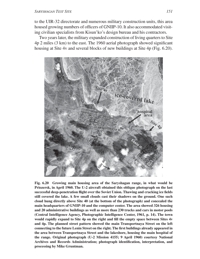
Elements of System A spread over hundreds of kilometers at Saryshagan (Fig. 4). In addition to Dunai-2 and three RTNs, it also included: 1) interceptor missile launch pads with an additional radar for missile initial guidance and then handing it over to RTNs for the final phase of the intercept; 2) highcapacity low-error microwave communication lines; and 3) a digital control computer with complex algorithms and codes.
Fig. 4 (see article pdf). System A at the Saryshagan test range. The dashed arrow shows approaching ballistic missile targets. Three precise tracking RTNs (yellow squares) form an equilateral triangle. Long-range Dunai-2 (orange rectangle) is to the south from the Saryshagan railroad station (S) and town Priozersk (P) with the main computer control center (red star). A blue arrow shows the launch site of V-1000 interceptor missiles with the nearby initial guidance radar. Microwave communications towers (magenta crosses and circled crosses) connected elements of System A. Original satellite photograph by KH-5 Argon mapping camera (Mission 9058A; August 29, 1963) courtesy U.S. Geological Survey; photograph identification, interpretation, and augmentation by Mike Gruntman.
A team under Vladimir P. Sosul'nikov designed the continuous wave Dunai-2 radar. They would form a core of a new institute, known today as the Scientific-Research Institute of Long-Range Radio Communications (NIIDAR). The U.S. intelligence nicknamed Dinai-2 "Hen Roost" after a U-2 mission had photographed it in April 1960 (Fig. 5). NIIDAR later built radars Dunai-3 (nicknamed "Dog House") and Dunai-3U ("Cat House") near Moscow for the fielded missile defense system A-35 and its upgrade A-35M.
Fig. 5 (see article pdf). Receiving antenna of the long range Dunai-2 ("Hen Roost") radar on the shore of Lake Balkhash. Top: photograph [9] courtesy of Mikhail Khodarenok; bottom: original photograph (U-2 Mission 4155; April 9, 1960) from National Archives and Records Administration; photograph identification, interpretation, and processing by Mike Gruntman.
The sizes of the transmitting and receiving antennas of Dunai-2 were 8×150 m and 20×150 m, respectively. They stood 1 km apart to minimize spillover. A slotted waveguide at the focal line of the parabolic cylindrical antenna carried electromagnetic radiation at the operational frequency near 200 MHz. It emitted a vertically oriented 0.6°×16° fan beam, with two transmitters combining their 40-kW power outputs. Linear frequency modulation enabled measurement of distances to the targets and electronically steered the beam. The receiver combined two antennas stacked on top of each other and pointed in slightly different directions. Dunai-2 detected typical warheads at distances up to 1200 km with a 1-km range accuracy and determined their elevation and azimuth with an accuracy of 0.5°.
The RTI institute of Mints built an alternative pulse long-range radar (TsSO-P), nicknamed by U.S. intelligence "Hen House." It operated at the 150-MHz frequency, had 15×250 m aperture, and emitted a narrow (in the horizontal direction) electronically steered fan beam that extended 20° vertically. Never used in System A, this development would lead to radar for ballistic missile early warning and for the antisatellite weapon system operationally deployed in late 1970s.
CIA deputy director for science and technology from 1963 to 1966 Albert "Bud" D. Wheelon noted that Hen Roost and Hen House at Saryshagan "were evidently steered electronically. This was an emerging technology at the time, and the development of these new radars near the missile impact area was startling. Even more startling was their size" [8]. In mid-1960s, the U.S. intelligence succeeded in characterizing emissions of these radars in some detail by measuring their signals scattered from the surface of the moon by 46-m antennas in Maryland and California.
The design bureau OKB-30 of Kisun'ko built three precise tracking RTNs operating at the 2-GHz frequency. Each unit consisted of two protected by radomes separate pulse radars with 15- and 4.6-m Cassegrain antennas. They determined distances to the target warhead and the interceptor missile, respectively. From measurements by three RTNs, the computer determined in real time the relative distance between the target and the interceptor with the error better than 10 m. The highly agile antennas (with masses 92 t and 8 t, respectively) could rotate within ±90° about each of the two axes with angular rates up to 13°/s. During operation in active tracking mode, each RTN consumed 650 kW of power. In 1958, an RTN prototype also demonstrated tracking of an artificial satellite, Sputnik-3, in orbit.
Special Design Bureau Fakel (OKB Fakel) under Petr D. Grushin built the V-1000 interceptor missile for System A. The two-stage interceptor with a solid-propellant booster and a liquid-propellant main stage launched from an inclined ramp.
The digital control computer of System A handed over the target missile from Dunai-2 to RTNs; calculated in real time an absolute position of the warhead from measurements of three distances by RTNs; integrated equations of warhead motion in the gravitational field of the Earth with aerodynamic drag in the atmosphere and predicted its trajectory; transformed coordinates among different reference frames; worked out the intercept solution; and generated commands for launch and guiding of the interceptor missile and finally for detonating its high-explosive charge. The computer controlled the final phase of the intercept, which lasted 12–14 s, without operator involvement.
The Institute of Precision Mechanics and Computer Engineering (ITMVT) under Sergei A. Lebedev had designed the M-40 computer for System A. Vsevolod S. Burtsev succeeded Lebedev as director of ITMVT in 1973 and later built Soviet supercomputers for the operational missile defense system and other applications. The M-40 relied primarily on vacuum tube technology, executed 40000 fixed point operations per second. Its random access memory had 4096 words and its external memory constituted 150 kwords. The main computer program, General Combat Code, operated the entire System A in real time.
The Central System Indicator (Fig. 6) of System A displayed the situation in an area 450 km in radius and plotted in real time the changing altitudes (up to 225 km) of the target and the interceptor during the final 130-s interval of the engagement. Microwave relay lines with the total length of 1230 km connected all system elements to the central control computer, with data transmitted at a rate of 100 kb s^-1) in a binary code organized as 14-b words through 16 independent channels with a 10^(-7) bit error rate.
Fig. 6 (see article pdf). Central System Indicator of System A. Photograph [9] courtesy of Mikhail Khodarenok.
IV. FIRST INTERCEPT
The military and engineers tried first intercepts of SS-3 (R-5) IRBMs in November 1960. In the third attempt on November 24, 1960 the interceptor passed at the distance of 21 m from the warhead and detonated on time, dispersing steel rods. It was anticipated that the rods would produce cumulative jets in high-velocity impacts. The target warhead, however, remained undamaged.
After this failure, Kisun'ko armed interceptors with an alternative warhead design of Konstantin I. Kozorezov. Each interceptor now carried more than 15000 spheres 24 mm in diameter with a 10-mm carbide–tungsten–cobalt core surrounded by high explosive. The interceptor detonated 0.3–0.45 s before passing a target and released the spheres creating a uniform disk field 50–75 m in radius with a high probability of hitting the target. The next three months witnessed ten more SS-3 intercept attempts but all failed due to malfunctioning components of System A or operator errors.
Then Kisun'ko switched to the new generation SS-4 (R-12) IRBM (Fig. 7) as a target. An operator of one RTN radar made an error in the first intercept attempt. The success came two days later on March 4, 1961. The Dunai-2 radar detected the approaching target at an altitude of 450 km and a distance of 975 km from the projected impact point. It locked on the warhead at a distance of 790 km. Then after some time the RTNs took over warhead tracking.
Fig. 7 (see article pdf). Mass-produced single-stage liquid-propellant intermediate-range ballistic missile SS-4 (R-12) with the 2000-km range. Photographs courtesy of Yuzhnoe Design Bureau, Dnipropetrovsk, Ukraine.
One vacuum tube of the M-40 control computer blew out right before the execution of the code calculating the intercept solution. Fortunately, spare vacuum tubes were mounted in an unused electronic rack in a warmed-up ready-to-work state; the computer also periodically dumped the status of the entire system to a magnetic drum memory. Engineers quickly replaced the vacuum tube and M-40 restarted execution of the combat code 145 s before the intercept. The RTN radars locked again on the target, the last one 95 s before the intercept, and resumed tracking. On command, the V-1000 missile launched 44 s before the intercept when the target was 158 km from the projected impact point. The final fully automatic phase of the engagement lasted 14 s.
The interception took place 60 km away from the V-1000 launch pad. The interceptor warhead detonated at an altitude of 25 km, approximately 0.4 s before the point of the closest approach to the target, with a miss distance 31.9 m. A special radio system installed in the inert target warhead stopped sending signals 6 s after the intercept. Later, search parties recovered parts of the destroyed target (Fig. 8).
Fig. 8 (see article pdf). Found in the desert pieces of the intercepted (March 4, 1961) warhead of SS-4 IRBM: 500-kg steel mockup of the ballistic missile warhead (top); ring frame (middle); nose section of the cone body (bottom). Frames from a Soviet documentary film (1961) about the first ballistic missile warhead intercepts by System A; uploaded to YouTube by vpknewsRU, http://www.youtube.com/watch?v=zbR_h__a5ZY&feature=youtu.be (accessed May 29, 2012); frame identification, interpretation, and processing by Mike Gruntman.
Trials of System A continued until 1964. The V-1000 missiles intercepted a total of 11 warheads of SS-3 and SS-4 IRBMs and destroyed six of those. System A also successfully overcame the first attempts of using passive (radar absorbing coatings and dispersed reflectors) and active (electronic) penetration aids. Thus, missile defense started the battle against penetration aids at its birth.
V. OPERATIONAL MISSILE DEFENSE AND BEYOND
In 1958, long before first intercepts by System A at Saryshagan, the government had authorized Kisun'ko to build an operational missile defense system for Moscow, the A-35. The requirements had been evolving and, by the mid-1960s, called for defense against up to eight warheads. This made a highly accurate method of three distances, with three radars for each target, impractical with too many radar units operating in the same limited space.
Therefore, Kisun'ko implemented a traditional, but less accurate, tracking of a target by a single radar. The resulting larger miss distances in interception called for more destructive interceptor warheads. Consequently, the operational missile defense system A-35 and its successors would be nuclear armed. In 1961 and 1962, the military conducted five dedicated nuclear interceptions of warheads at Saryshagan to determine their effectiveness and characterize effects of nuclear explosions on radar. (We note that the United States demonstrated nonnuclear intercepts of short-range tactical missiles in 1960 [1 (website)], simulated nuclear intercept of an ICBM in 1962, and also adopted nuclear intercepts for strategic missile defense in the 1960s and the 1970s.)
The success of System A put the Soviet Union on the road toward operational missile defense. By the late 1960s, emergence of penetrating aids and arming ballistic missiles with multiple reentry vehicles had changed the requirements to the operational system; it had to defend Moscow against eight pairs of targets. Leading weapon designers and officials disagreed on directions of further development of missile defense. Nevertheless, the A-35 first phase went on combat duty in July 1973. Its modernized version A-35M became operational in May 1978. By that time power struggle in the defense establishment led to firing, in 1975, of their chief designer Grigorii Kisun'ko. Influential Alexander Mints also lost his job for opposing the administrative changes in the early 1970s.
Numerous research institutes, design bureaus, industrial plants, and military units engaged in missile defense and related areas. These programs played a major role in advancing electronics and computing in the country. The Soviet Union deployed the Space Control System focused on space situational awareness and the Ballistic Missile Attack Early Warning System. The latter included ground radar and optical and infrared sensors on satellites. Another expensive program strived to develop early warning over-the-horizon radar and remained controversial for many years. Antisatellite weapons reached operational status in the 1970s. Also at that time, the missile defense and space establishments initiated a major effort in space-based weapons, including a laser space battle station Polyus (Skif-DM). The launch of the gigantic 37-m-long 80-metric-ton partially completed prototype of Polyus, authorized by Soviet leader Mikhail S. Gorbachev, failed due to a design error on May 15, 1987.
The breakup of the Soviet Union in the early 1990s led to major changes in the military-industrial complex of the country. Nevertheless, Russia deployed the new missile defense system of Moscow, the A-135, in those uncertain times. It is operational today. The Saryshagan test range ended up in the independent Kazakhstan. Russia is leasing parts of the proving ground while abandoned installations decayed. Grigorii Kisun'ko died in 1998. Reorganization of the defense industry ultimately led to the formation of one dominating governmentcontrolled association Almaz-Antei that placed the most important research, development, and production organizations in air and missile defenses under one corporate roof.
More than 50 years ago, the pioneers in the Soviet Union and the United States blazed the trail in search of technical means for defense against deadly ballistic missiles. As life goes on and new threats emerge, the eternal competition between the sword and the shield continues.
References
See article
pdf

Sputnik Explorer Vanguard Astronautics Missile defense Baikonur Tyuratam Saryshagan Rocket equation Rocket espionage U-2 Neil Armstrong USC
Mike's books
–
Mike's space and rocket videos –
Make the world a better place
The Man Who Shot Down a Long-Range Ballistic Missile: 100th Anniversary of the Birth of Grigorii V. Kisun'ko
69-th International Astronautical Congress, IAC-18-E4-1-08, Bremen, Germany, 2018

Abstract
In 1961, the Soviet Union demonstrated the first intercept and destruction of a warhead of a long-range ballistic missile. This consequential event led to the birth of Soviet missile defense and paved the way to fielding the operational missile defense system A-35 in 1970s and its successor A-135, protecting Moscow today. Missile defense played a prominent role in formulating policies during the Cold War. At the same time, very little is known about the pioneers who led this development. Missile defense also branched into several important technical and operational space areas such as early warning of ballistic missile attack, space situational awareness, and space and antisatellite weapons. This paper presents a story of Grigorii V. Kisun’ko, 1918–1998, an accomplished scientist and engineer who significantly contributed to design of the first Soviet antiaircraft missile system S-25 (SA-1) and then proposed and built the Experimental System A that achieved the first nonnuclear intercept of a long-range ballistic missile warhead. In 1960s and 1970s, Kisun’ko led development of the first operational missile defense system A-35. He was fired in 1975 in the internal struggle in the Soviet defense establishment. This year marks the 100th anniversary of his birth. The life of Kisun’ko reflected a complex turbulent history of the twentieth century.
1. INTRODUCTION
In July 1962, Soviet leader Nikita Khrushchev met with a group of visiting U.S. newspaper editors. “I know what antimissile systems are since we have them,” said Khrushchev with confidence and pride, “our missile, one can say, hits a fly in space” [1].
By this time the new futuristic system had intercepted and destroyed several warheads in tests. The events paved the way for emergence of a powerful political, military, scientific–technological, and industrial missile defense complex in the Soviet Union. A new important chapter in the eternal competition between protecting and avenging, between the sword and the shield, has begun.
The first operational missile defense system A-35 deployed in early 1970s, protecting the Soviet capital Moscow. Its successor A-135 stands in combat readiness today. The missile defense program also led to development of optical and radar monitoring of orbiting space objects; early warning of ballistic missile attack; and space and antisatellite weapons.
The first intercept of an approaching warhead of an intermediate range ballistic missile (IRBM) R-12 (SS-4) took place on March 4, 1961 in the Kazakhstan desert. The spectacular nonnuclear destruction of a warhead represented an achievement on par with other important Soviet firsts of that era: demonstration of the first intercontinental ballistic missile R-7 (SS-6) and launch of the artificial Earth satellite Sputnik in August and October, respectively, of 1957 and an orbital flight by the first cosmonaut in 1961. In spite of its importance, the consequential missile defense feat remained poorly known in the Soviet Union and in the world.
The first intercept stood out as especially impressive because it relied on advanced electronics, sophisticated radar, high-speed communications, and control in real time by a digital computer. The Western public and media rarely viewed these areas of military technology as being particularly strong in the Soviet Union.
A number of corporate histories and memoirs of participants of those historic events, e.g. [2-5], appeared in Russia after the collapse and disintegration of the Union of Soviet Socialist Republics (USSR) in the early 1990s. In the West, the first comprehensive book in English, crossing the language barrier, was published in the open literature in 2015 [6], followed by a short journal-article version [7]. The book [6] provides extensive references to the Russian publications.
Missile defense is a complex technical area. Policy debates on the subject and media accounts are sometimes shallow in substance and not always informed, with ideologically driven narratives common. Missile defense and global warming share the "distinction" of being perhaps the most politicized consequential areas of science and technology.
This year marks the 100th anniversary of the birth of Grigorii V. Kisun’ko, an accomplished scientist and engineer who led development of early Soviet missile defense and achieved the first IRBM warhead intercept. This paper tells his story.
2. Rearmament after WWII
|
|
|
Public policy. Copyright © 2004–2016. All rights reserved.